
U.S. Tariff Reset 2026: What the Supreme Court Ruling Means for Small Businesses
U.S.

📌 Summary [Updated 03.03.26]: From August 29, 2025, the United States ended the long-standing de minimis exemption. Low-value international packages no longer enter duty-free, even under $800. All commercial imports can now face duty, tariffs, and carrier fees.
In February 2026, the U.S. Supreme Court ruled that certain tariffs imposed under emergency powers were unlawful. This changed some tariff authority, but did not restore de minimis.
These changes hit small sellers hardest, especially low-cost items like stickers and magnetic bookmarks. Stickiply uses clear duty calculations so customers see the full landed cost at checkout.
For practical steps, read: How Small Businesses Can Survive the U.S. Shipping & Tariff Shake-Up .
⚖️ New U.S. Tariff Rules: Core Facts
De minimis ended: From August 29, 2025, shipments that previously entered duty-free under $800 no longer get that treatment. This increases paperwork, duty exposure, and delivery risk for low-value parcels.
Supreme Court ruling (Feb 2026): The court limited the use of emergency powers for certain tariff actions. That decision changed parts of the tariff approach, but did not bring back de minimis.
Bottom line: If you ship into the U.S., assume duty and import processing applies.

President Trump signing the executive order that suspends the U.S. de minimis exemption starting August 29, 2025. Photo: AP / Reuters via ABC News
📉 How This Hurts Small Sellers
De minimis used to make low-value parcels viable. Without it, small orders often become “all fees, no margin.”
Previously:
- Sell a $5 sticker to a U.S. buyer
- Ship via Royal Mail → USPS
- No duty for most sub-$800 parcels
Now:
- Even low-value orders can enter the duty system
- Duties, tariffs, and handling charges can apply
- Bad customs data leads to delays, returns, or extra fees
Key takeaway: every shipment needs clean customs data (accurate item descriptions, HS codes, values, origin).
Shipping original artwork (paintings, limited prints, drawings, sculptures)? Treatment can differ by classification. Read: Hyper Lux Magazine overview .
🔍 What Was De Minimis?
De minimis allowed U.S. customers to import goods under $800 without paying customs duty. It reduced friction for international shopping and helped small businesses sell low-cost items internationally. From August 29, 2025, that exemption ended.
⚠️ What This Means for Buyers & Sellers
- International parcels to the U.S. can be assessed for duty, regardless of order value.
- Courier routes (UPS, FedEx, DHL) tend to apply value-based duty plus a brokerage or clearance fee.
- Postal routes can still work, but poor customs data increases delivery risk.
Read more about the end of de minimis here: The Verge.
🔍 Section 301 Tariffs & Why Origin Matters
Section 301 is a U.S. trade measure introduced in 2018. It adds extra tariffs on many goods originating from China, often up to 25% depending on the product’s classification.
This matters for the sticker and print industry because many supplies (vinyl films, laminates, plastics, accessories) are China-origin even when sold by UK businesses.
The February 2026 Supreme Court decision did not remove Section 301.
Important distinction:
- Courier and formal commercial entries: Section 301 applies when classification and China origin trigger it.
- Postal shipments: many low-value postal flows have not consistently had Section 301 assessed in practice under simplified processing.
- Change scheduled for May 2026: postal handling is expected to move toward the same assessment standards, meaning Section 301 is more likely to be applied where relevant.
📦 Real Cost Breakdown, Courier Examples (With Section 301)
Assumptions for the examples below: duty rates shown are examples based on typical classification outcomes for these product types. Your final rate depends on HS code, declared origin, and entry method.
| Scenario | Item value | Base duty (example) | Baseline tariff (15%) | Section 301 | Total import charges | Landed product total |
|---|---|---|---|---|---|---|
|
A. UK-origin finished goods $100 stickers + $100 magnetic bookmarks |
$200.00 | $10.70 (5.8% of $100 = $5.80) (4.9% of $100 = $4.90) |
$30.00 | $0.00 | $40.70 | $240.70 |
|
B. China-origin supply Example: $100 laminate or vinyl supply |
$100.00 | $3.40 (example 3.4% duty) |
$15.00 | $25.00 (example 25% 301) |
$43.40 | $143.40 |
📄 Brokerage fee: courier shipments often include a brokerage or clearance fee. The amount varies by carrier and service level.
💡 Why Section 301 matters: on China-origin supplies, Section 301 can be the biggest line item, bigger than base duty.

🚚 How Stickiply Prepared for These Changes
Stickiply moved to a managed shipping and duty process using Teleship. This supports strong customs data, clearer duty calculation, and fewer surprise charges.
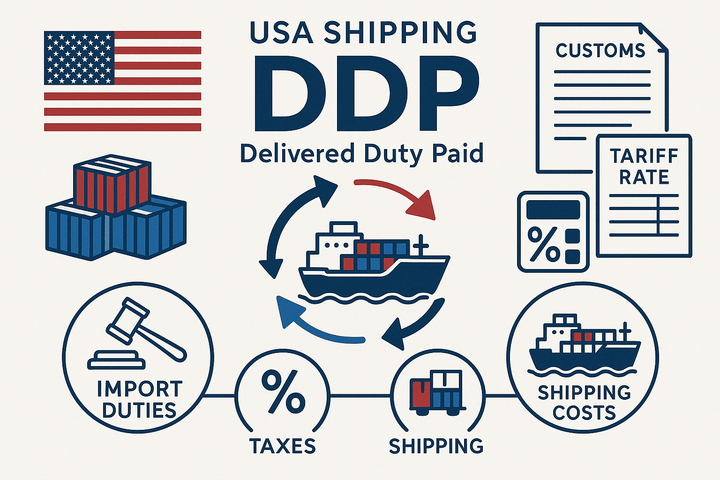
All U.S. orders are shipped Delivered Duty Paid (DDP), meaning duties and clearance costs are calculated at checkout through Shopify. Customers see the full landed cost before placing an order.
Teleship can route through USPS, UPS, FedEx, and other final-mile options depending on location, service level, and customs routing.
We continue to:
- Declare accurate product values and breakdowns
- Provide full commercial invoices with HS codes
- State country of origin per item
- Prepay duties where possible
- Monitor tariff changes and update this post
Tariffs are outside our control. Clear checkout pricing and clean customs data are not.
In the UK, we still use Parcel2Go Smart Send as part of our fulfilment workflow. This connects Shopify and other sales channels into one shipping pipeline.
- - -
🏛 A Brief History: What Changed?
De minimis originated under the Tariff Act of 1930. It increased over time, reaching $800 in 2016 under the Trade Facilitation and Trade Enforcement Act. In 2025, it was suspended for international shipments into the U.S., changing how low-value eCommerce works.

🤔 What Small Businesses Should Do Next
✅ Increase average order value
Encourage bundles and multi-packs. A $30 order absorbs fees better than a $5 order.
✅ Fix customs data
Use correct HS codes, clear product descriptions, accurate values, and origin per line item.
✅ Use checkout transparency
Show landed cost at checkout where possible. Surprise fees drive refunds and disputes.
✅ Track origin on supplies
If you sell supplies, origin matters. China-origin goods can trigger Section 301.

🫂 Note from the Stickiply Team
We will keep updating this post as U.S. rules change. We do not profit from shipping or tariffs. These are external costs.
If you have questions, email hello@stickiply.com or view our shipping policy.
Sources
- Teleship: U.S. Tariffs and Supreme Court Ruling
- White House: De Minimis Suspension (July 2025)
- Reuters: U.S. ends parcel tax relief
- The Verge: International packages get more expensive
- Barron’s: Import tax exemptions ended
- U.S. Supreme Court decision (PDF)
- Case background summary
- EY: De minimis suspension summary
- CFR: Tariffs analysis after the ruling
- Hyper Lux Magazine: Artwork and tariffs

Keep reading
US Customs Changes: What Actually Happened On 24th July
On 24th July 2026 the US 10% global tariff expired and was replaced the same minute by a Section 301 forced-labour tariff with no expiry date.

New EU €3 Customs Duty: What 1st July 2026 Means for Your Orders
From 1 July 2026, the EU introduces a flat €3 customs duty on every parcel under €150. Here is how the new rules work and what you will pay at checkout.
No More Hidden Fees: How We Ship to the U.S. With Tariffs prepaid
With U.S. customs tightening from August 29th, we’ve set up DDP shipping using Teleship, a game-changer for small UK businesses selling to the U.S.

How Small Businesses Can Survive the U.S. Shipping & Tariff Shake-Up
U.S. shipping rules are changing: flat postal penalties and new tariffs could devastate small sellers worldwide. This guide breaks down practical ways to adapt, from bundles and...
Comments · 4
Girl In A Whirl UK
Thank you for writing this article, it’s explained this nightmare very clearly. What a rubbish situation this is for us small businesses!
Desiree
This is an excellent article, and I thank this company for taking the time to write it. Sadly, this issue isn’t getting nearly enough traction, so Americans don’t understand how they are about to be levied a brand new tax. I despair the harms it’ll cause to small business owners all around the world who are trying to make an independent living.
Also, thank you for letting me know that the USPS is going to do flat rate. I have a package shipping from India of Indian- origin goods, and they were slapped with a 50% total tariff. I’m terrified I’ll be charged $200 if the delivery is slow. I’m so sad about all of this. 😞
Anthea Barnes
Thank you for this information it has been so helpful. I am a small business and was about to shut down to the US which could have meant closing completely but maybe I can use your suggestions and keep going.
Jane Fondeu
This is just insanity at this point. We didn’t vote for this.