
US Customs Changes: What Actually Happened On 24th July
On 24th July 2026 the US 10% global tariff expired and was replaced the same minute by a Section 301 forced-labour tariff with no expiry date.

📌 Summary: This post was written before 24th July 2026. Here is what actually happened, updated 23rd August 2026. The temporary 10% global tariff did expire that day - but it was replaced the same minute by a new Section 301 "forced labour" tariff that has no expiry date. UK-made goods pay 10%, Chinese-made goods pay 12.5%, both stacked on top of normal duties. The postal change went ahead exactly as expected: parcels sent into the US by post lost their simplified flat-rate clearance and now go through a full entry process.
The original version of this article expected the 10% surcharge to fall away and leave UK goods facing only their low base duty. That is not what happened. The sections below have been rewritten against what is now in force, and the sources at the end have been replaced.
What actually happened on 24th July
Two things happened at 12:01am US Eastern Time, and they landed back to back with no gap between them.
The temporary 10% global tariff, brought in under Section 122 of the Trade Act of 1974, hit its hard 150-day limit and lapsed by operation of law. Congress did not extend it.
In the same moment, the US Trade Representative brought in a replacement. New tariffs under Section 301, this time justified by whether a country enforces bans on goods made with forced labour, took effect on imports from around 60 economies covering roughly 99.4% of everything the US imports.
The replacement, and why it matters more
The new tariff has two tiers. Countries that ban forced-labour imports, or have committed to, pay 10%. Everyone else pays 12.5%.
The important difference from the tariff it replaced is not the rate. It is the shelf life. Section 122 had a 150-day sunset written into the law itself, which is why it expired. These Section 301 duties carry no statutory expiration. They stay until they are actively removed.
They also stack. The new percentage is added on top of the normal duty rate for the product, plus any anti-dumping or countervailing duties, plus - for Chinese goods - the long-standing Section 301 China duties that already applied.
Postal parcels did lose their shortcut
This part of the original article held up. From 24th July, goods valued at $2,500 or less arriving through the international postal network moved onto a new, considerably more demanding entry process.
The flat per-item duty is gone.
Duty is now charged as a percentage of the declared value of the goods, not a simplified flat fee.
A full 10-digit tariff code is required.
Not a 6-digit category. The last four digits set the exact rate.
A customs bond is required.
Filers must hold a continuous bond before a postal entry is accepted at all.
Monthly reporting.
An International Mail Duty Worksheet has to be submitted each month, alongside per-parcel data: origin, value, duty rate, duty owed, carrier and tracking.
US Customs expects the change to bring in over $100 million a year in duties that previously were not collected. In plain terms, a parcel sent by post is now treated like any other commercial import.
What this means for your basket
It still splits down the middle, but neither side got the relief we were hoping for.
Stickers, magnetic bookmarks & other custom products made in the UK
Our Create items are printed, laminated, cut and finished in our UK workshop, so their country of origin is the UK. That puts them in the lower 10% tier, on top of the standard base US duty for paper and sticker goods, which remains low.
So a UK-made order lands in much the same place it did before 24th July. What changed is that the 10% is no longer temporary.
Printable vinyl, laminates, photo paper, crafting tools & more
Our printable vinyl, laminate films, photo papers and most tools are made in China, so they carry Chinese origin on customs documents. Packing and shipping them from the UK does not change where they were made.
These now attract the higher 12.5% tier. That sits on top of the base duty for the product and on top of the existing Section 301 China duties that already applied to plastics - and, because the postal shortcut has closed, all of it is now calculated as a percentage of value rather than a flat per-item fee.
For a US customer, supplies cost more after 24th July than before it, and that is unlikely to reverse on its own. Create items are close to where they were. We show all duties at checkout for your review, so nothing lands as a surprise on the doorstep - the only thing we cannot include is local sales tax where your state charges it.
Our UK-made Create range remains the cleanest and lowest-cost thing to order into the US. For supplies, the duty is driven by Chinese origin and plastics tariffs rather than by us, and fewer, larger orders spread the per-parcel customs cost over more items instead of paying it on lots of small ones.
Made in our UK studio, with the lowest US duty: custom stickers and magnets and custom magnetic bookmarks.
Supplies cost less per item in one larger order: printable vinyl, laminates and photo papers.
The court case, and whether any of it comes back
Worth knowing if you paid the 10% surcharge yourself. The US Court of International Trade ruled that the Section 122 surcharge exceeded the President's statutory authority - but it limited relief to the three importers who actually brought the case.
The government appealed, and the Court of Appeals for the Federal Circuit stayed the ruling while it considers it. So the surcharge continued to be collected from everyone, including the importers who won, right up to its expiry. If the decision is ultimately upheld, refunds for other importers may become possible. Nothing is owed to anyone yet.
We extended our HS codes from 6 digits to the full 10, checked every product's country of origin, and rewrote our customs descriptions in plain physical terms.
Our US checkout collects duties up front, calculated per item from its origin and its full tariff code, rather than relying on the simplified postal rates that no longer exist.
If you ship to the US yourself
What we would check now, a month on. Skip this if you are a customer rather than a seller.
10-digit codes are no longer optional
Postal entry will not accept a 6-digit category. If your catalogue still carries short codes, that gap becomes a delay or an unexpected bill for your customer.
Check who holds the bond
Postal entries now need a continuous customs bond behind them. If you send by post, confirm your carrier or broker is filing under one - this is the requirement most sellers did not see coming.
Re-price your Chinese-origin lines
If you sell goods made in China into the US, the 12.5% is additional to everything that applied before, and it is calculated on value now rather than a flat fee. Margins set before July are probably wrong.
Do not budget for the tariff going away
The replacement has no sunset clause. Treat it as the new normal rather than a temporary measure to wait out.
Questions?
If you have a question about how these changes affect a specific US order, email us at hello@stickiply.com and we will do our best to help. We are writing from our own reading of the information available on 23rd August 2026, and this is not a substitute for formal legal or customs advice.
Sources and further reading
- USTR, "USTR Takes Action in Forced Labor Section 301 Investigations". The official announcement of the replacement tariffs and the two-tier structure.
- Holland & Knight, "New Section 301 Forced-Labor Tariffs Imposed on 60 Countries". Which countries fall into the 10% and 12.5% tiers, and how the duties stack.
- Honigman, "Section 122 Tariffs Expire for Many Imports, But New Section 301 Forced-Labor Tariffs on 60 Economies Replace Them". The handover at 12:01am on 24th July, and why there was no gap.
- Customs & International Trade Law Blog, "De Minimis, Codified: CBP Finalizes the Postal Suspension Rule". The new postal entry process, the bond requirement and the International Mail Duty Worksheet.
- Skadden, "US Trade Court Strikes Down Section 122 Tariffs, but Ruling's Fate Is Uncertain". The CIT decision, why relief was limited to the three plaintiffs, and the appeal.

Keep reading

New EU €3 Customs Duty: What 1st July 2026 Means for Your Orders
From 1 July 2026, the EU introduces a flat €3 customs duty on every parcel under €150. Here is how the new rules work and what you will pay at checkout.
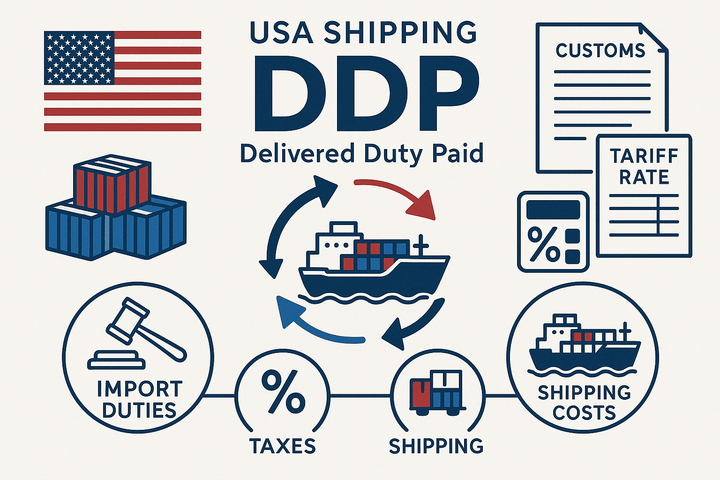
No More Hidden Fees: How We Ship to the U.S. With Tariffs prepaid
With U.S. customs tightening from August 29th, we’ve set up DDP shipping using Teleship, a game-changer for small UK businesses selling to the U.S.

How Small Businesses Can Survive the U.S. Shipping & Tariff Shake-Up
U.S. shipping rules are changing: flat postal penalties and new tariffs could devastate small sellers worldwide. This guide breaks down practical ways to adapt, from bundles and...
U.S. Tariff Reset 2026: What the Supreme Court Ruling Means for Small Businesses
U.S. tariffs changed again in 2026. A 10% baseline tariff now applies to most imports, while Section 301 duties on Chinese goods remain. Here is what Etsy sellers, Shopify store...
Comments
Be the first to comment.